

Digital loyalty cards for retail stores
Give shoppers a digital loyalty card for retail stores in Apple Wallet and Google Wallet: points, VIP levels, coupons and gift cards. Start free today.
Updated October 2026
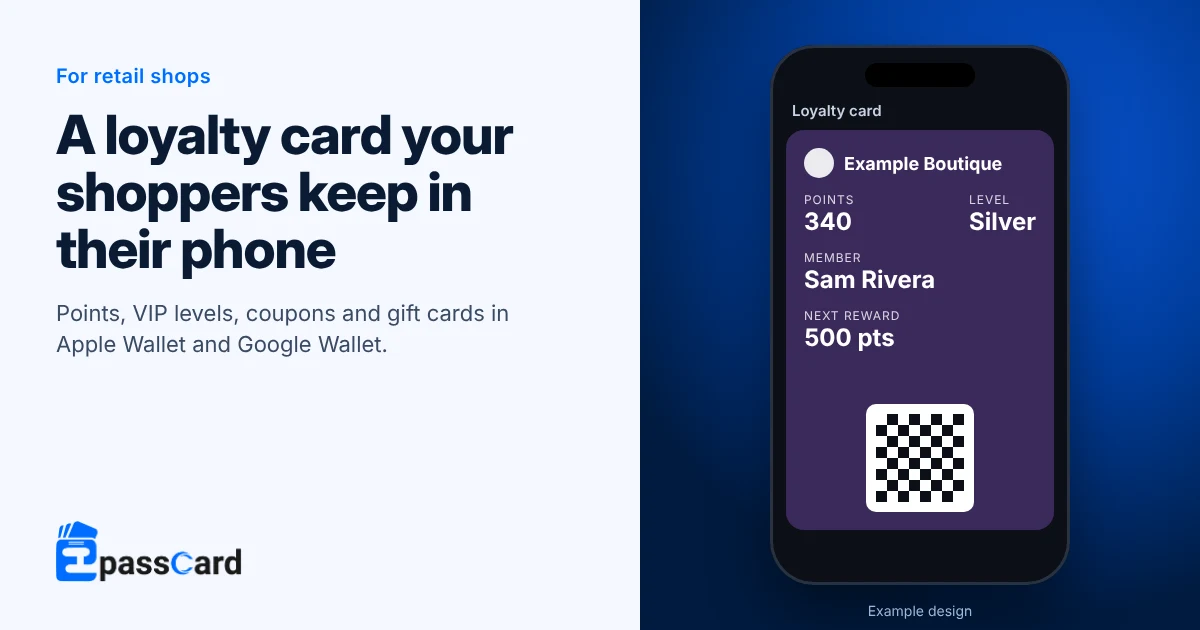
A digital loyalty card for retail stores is a points or VIP card that shoppers keep in Apple Wallet or Google Wallet. With EpassCard, a shopper joins by scanning a QR code at your register, and staff add points by scanning the card. You can add coupons, gift cards and lock-screen reminders near your shop.
Key takeaways
- Shoppers add the card to Apple Wallet or Google Wallet from a QR code or link, with no app to install.
- One account can run points, VIP levels, coupons, gift cards and store credit.
- Staff add points with the free scanner app. Your POS can do it through the API if a developer connects it.
- Up to 10 shop locations can bring the card to a shopper’s lock screen when they are nearby.
- The Free plan covers 50 live passes; Growth is $39 a month for 1,000 (as of October 2026).
Which passes fit a retail loyalty program?
A shop usually starts with one points card and adds offers around it. Each pass is a template you design once for both wallets.
| Pass | What it does in a shop |
|---|---|
| Loyalty card | A points total and a level such as Silver or Gold. Staff add points at checkout with a note. |
| Customer card (VIP) | A category and customer ID for members-only offers and early access. |
| Coupon | A one-time sale or launch offer with an expiry date. It is used up once claimed. |
| Gift card | Prepaid value. Staff deduct each spend, and a spend above the balance is refused. |
| Store credit card | A balance shoppers top up and spend, such as credit after a return. |
Apple’s store card pass style, which these cards use, is meant for discount, gift and store loyalty cards (Apple Developer: store card passes).
How should you set rewards and levels?
Keep the first reward close and the rules short enough to fit on the back of the card. Most shoppers decide in a few seconds whether a program is worth joining.
- Pick one earning rule. For example, 1 point per $1 spent, entered by staff at checkout. Write it on the back of the card.
- Make the first reward reachable. If a typical basket is $40, a reward at 200 points arrives on the fifth visit, not the fifteenth.
- Use levels for your best customers. A Silver or Gold level is a text field on the card. Change it when a shopper qualifies, and the card updates.
- Give levels a real perk. Early access to a sale, a birthday coupon or free alterations matter more than a badge.
- Decide what happens to old points. If points expire, say so on the card. A balance that disappears without warning frustrates shoppers.
How does a wallet loyalty card work in a shop?
The card does the job of a plastic card at checkout, and it also gives you a way to reach shoppers between visits.
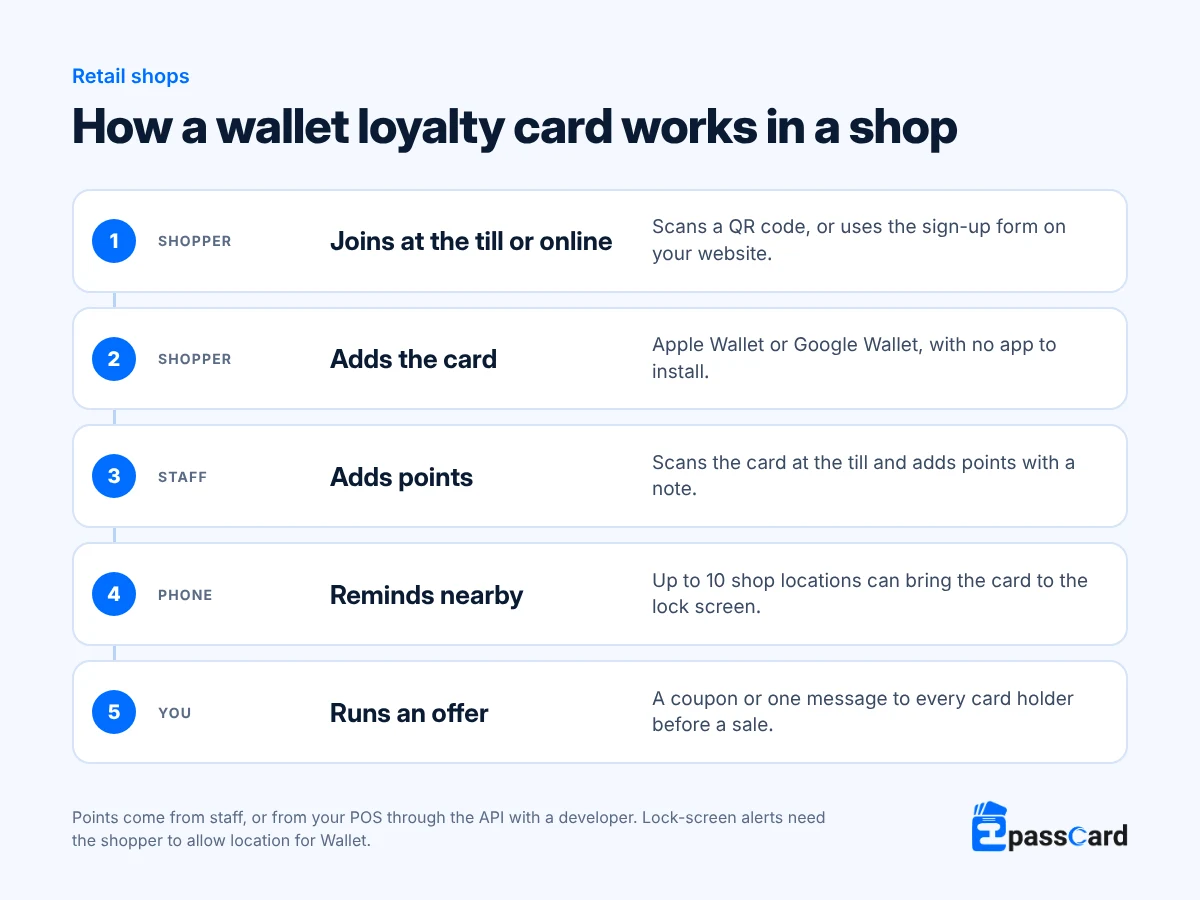
When staff add points, the shopper’s card updates and shows a short message, usually within about a minute. A sale starting Saturday can go to everyone holding the card in one message. Shoppers choose to add the card and can drop it anytime, so marketing consent and privacy rules still apply to what you send. Google Wallet sends a phone alert for up to 3 messages per pass in any 24 hours (Google Wallet developer docs).
Example: how a fashion boutique in Toronto would set it up
Illustrative scenario, not a customer. A boutique with two stores and a seasonal pop-up wants its best customers to hear about new collections first.
- A loyalty card with points and a VIP level. Staff add points at checkout; the card does not read the register total.
- Both stores and the pop-up are saved as locations, so the card shows on the lock screen nearby.
- Before a new collection, every card holder gets one push message and a coupon valid for 7 days after they add it.
- Sales associates have scanner roles for points and redeem only. Managers handle gift card balances.
Example: how a bookstore in Melbourne would set it up
Illustrative scenario, not a customer. An independent bookstore replaces a paper points card and wants online visitors to join too.
- The sign-up form sits on the bookstore’s own website, so online visitors get a card as well.
- Store credit from returns goes onto a store card with a balance, instead of a paper slip.
- Christmas gift cards are sold at the counter and sent to the buyer by email link.
- A monthly message tells card holders about author events and new arrivals.
Does it work with your POS?
Not directly. You can run the card next to your POS, or connect your POS through the API. Choose the one that fits how much you want to change at checkout.
| Route | How points get added | What you need |
|---|---|---|
| Scanner app | Staff scan the card and add points by hand | A phone or tablet at checkout |
| API and webhooks | Your POS or ecommerce system updates the card | A developer to connect it |
There is no ready-made POS integration or Shopify app. If your online shop runs on WooCommerce, the free EpassCard WordPress plugin includes a points program with Bronze to Platinum tiers.
How do you set up a digital loyalty card for retail stores?
- Create a free account at app.epasscard.com.
- Build a loyalty card from the Store card preset with name, member ID, points and level.
- Add coupon and gift card templates for your next sale.
- Save each shop as a location and write the lock-screen line.
- Print the QR code for the register and receipts, or embed the sign-up form on your website.
- Set staff roles so cashiers can add points while only managers adjust balances.
What does it cost?
Plans are priced by the total number of live passes you hold at once, including coupons and gift cards that are still active.
| Plan | Live passes | Templates | Monthly | Yearly |
|---|---|---|---|---|
| Free | 50 | 3 | $0 | $0 |
| Starter | 250 | 5 | $19 | $156 |
| Growth | 1,000 | 10 | $39 | $324 |
| Business | 5,000 | 25 | $65 | $540 |
Prices from the EpassCard pricing page as of October 2026. Push messages and API access are included on every plan. Larger chains can ask for a Retail Enterprise quote.
For example, a shop with 600 loyalty members, 150 active coupons and 100 gift cards holds 850 live passes. That fits Growth at $324 a year on yearly billing. Starter would cover the 3 or 4 templates but not the 850 live passes.
What it does not do
- It does not calculate points from a purchase amount on its own. Staff or your connected system add them.
- It does not take payments. Gift cards and store credit cards track a balance; money is taken at your register.
- Google Wallet passes run in demo mode until you complete Google’s one-time business verification. The app links to the steps.
- There is no NFC tap at checkout. Staff scan the barcode.
- Lock-screen alerts need the shopper to allow location for their wallet.
Gift card rules: in the US, federal rules generally stop gift card funds expiring within 5 years of issue or last load (12 CFR 1005.20). States can add stricter rules, so check local law before you set an expiry.
FAQ
Can shoppers add my store’s loyalty card to Apple Wallet without an app?
Yes. Print the QR code on receipts or a counter sign, or send the link in your newsletter. Shoppers on iPhone get an Apple Wallet button and Android shoppers get Google Wallet. Nobody installs an app or creates an account to join.
How do staff add points at checkout?
Staff open the free EpassCard scanner app, scan the card and enter the points with an optional note. The shopper’s card updates with a short message. Staff roles let you allow points and redemptions for sales associates while keeping balances for managers.
Can one loyalty card work in all my store locations?
Yes. Staff at every location scan the same card, and each scan is logged with the staff member and source. You can save up to 10 locations, so the card can appear on a shopper’s lock screen near any of them.
Can I keep gift cards and store credit on a wallet card?
Yes. Turn on balance and transactions for a gift card or store credit card. Staff deduct each spend, and the system refuses a spend larger than the balance. Every change is logged and emailed to the holder. The money itself is taken at your register.
How much does a digital loyalty card cost for a small shop?
A small shop can start on the Free plan with 50 live passes and 3 templates. Starter is $19 a month for 250 live passes, and Growth is $39 for 1,000, as of October 2026. Active coupons and gift cards count toward the total.
Start your loyalty card free
Set up your card and test it with your first 50 shoppers on the Free plan, with no credit card needed. Start free, or book a demo for a chain.